
In 2005, I became aware of the profound implications of resource depletion on the future of industrial civilization. It started with the cover article in the June 2004 issue of National Geographic, “The End of Cheap Oil”, which detailed the concept of Hubbert’s Peak and described what was then publicly known about the state of world oil reserves. Then there was the book The Long Emergency by James H. Kunstler, and many websites and blogs such as Life After the Oil Crash (LATOC), The Oil Drum, Energy Bulletin, and The Archdruid Report. I was also part of a local peak oil discussion group that spent a lot of time doings things like looking at graphs like the one below and pondering the implications for the world.
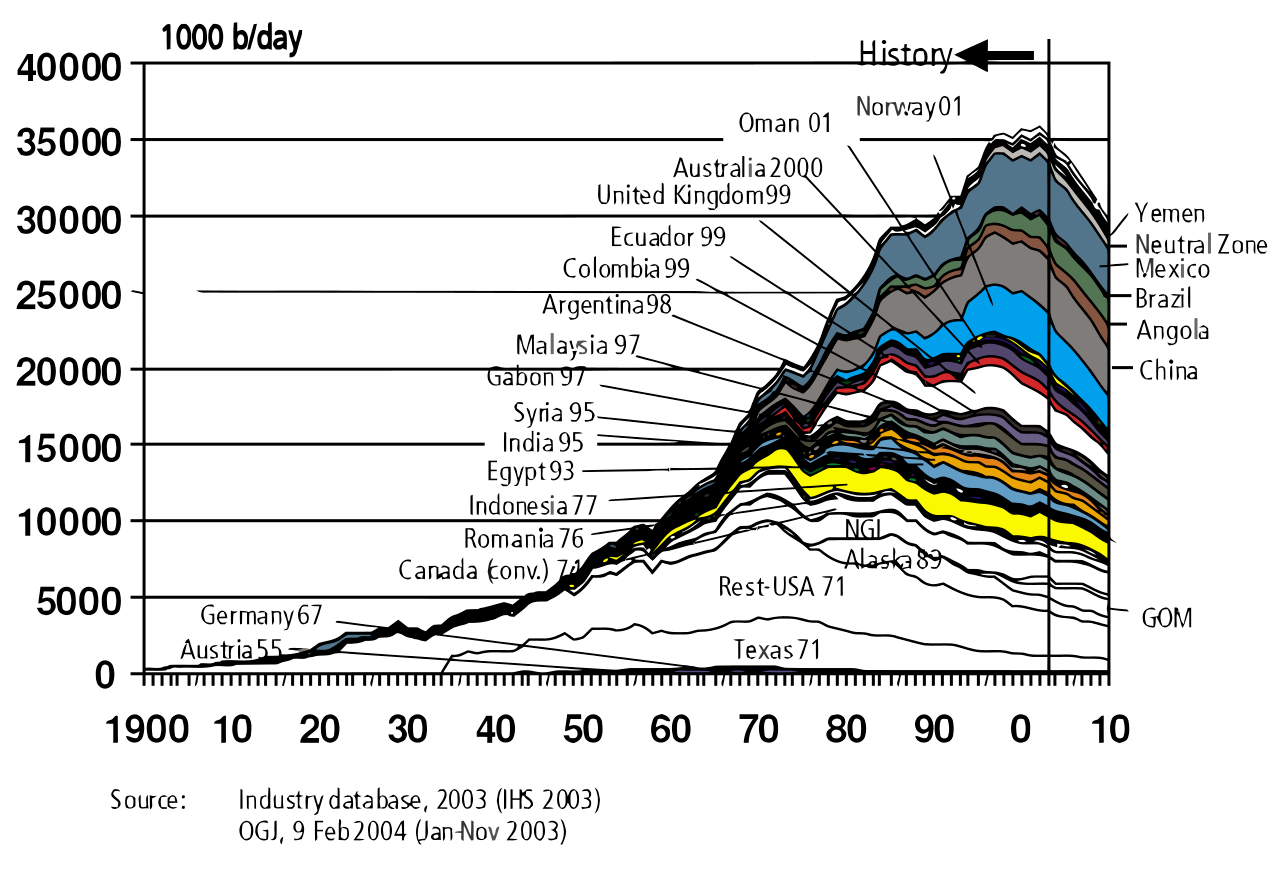
Because most of the peak oil groups and websites have vanished, it might seem that this is an issue that is no longer of concern, but I think a better explanation is that they predicted correctly the overall future that we are now living in, which is cascading failures of political, economic, and cultural systems. In 2005, very few people outside of these small discussion groups were talking in serious terms about economic and political collapse and the decline of industrial civilization, and people who did talk about these things were considered crackpots, at best. Now, in 2026, discussion of these topics occurs daily throughout our society.
Since 2005, I have been engaged in a search for answers to the question of “how should we live in light of this reality?” I have spent a great deal of time and thought considering this question, and experimented a fair bit with different approaches to answering it and attempting to live out those answers. I hope that it is not conceited of me to think that I may have learned at least a few things.
A second question that has also consumed me has been “how do I share what I have learned with others?” Since the first question flowed from a worldview that, twenty years ago, was almost impossible to articulate in polite company, sharing answers to it was similarly difficult. As times have changed, though, this has become easier, and in my writing I intend to share some of my perspective on our situation as it now stands.
So, if you want a one-line answer to what this is all about: These dispatches are reflections on living as a human being during the crisis of industrial civilization.
Many Peak Oil thinkers initially were optimistic that if they could get their message out, governments and the public could rally around solutions that would enable the world to meet the challenge of resource depletion in responsible and effective ways that would equitably distribute the burdens of transitioning to new ways of organizing ourselves economically, politically, and culturally. Two decades later, it is clear that no such thing will happen. What does this mean for us?
It appears to me that the most likely and effective responses to the challenges of our age will start with individual responses, and work up through families and into local communities and churches. Accordingly, my writing will focus on what individuals can do to build up and prepare themselves and their families for the challenges we are or may soon be facing. After laying this foundation, I will also be discussing what families can do to help their neighbors and local churches weather the storms ahead.
Having outlined this plan, I know from previous blogging experience that I have a tendency to digress and wander off into other topics somewhat impulsively, so you may be hearing about subjects that don’t neatly fit into the scheme I have laid out.
Going forward, I plan to post at least once each month, and all of my posts will be free to read. If you would like to support my work, visit my Support page to learn how. I hope you find what I write to be informative and useful, and I welcome whatever feedback you may have.
Bravo for beginning this new substack! I look forward to your posts. Based on JMG's recent post on "The Rowling Effect" perhaps you should consider being as offensive as possible to as many extremists as possible? (I'm only half kidding)